Jun 18, 2026 - 14 min read
Production RAG, Part C: Guardrails, Evaluation, and Observability
How to measure grounded answers, contain failures, trace behavior, and operate RAG safely—the part of the system that prepares for inevitable mistakes.
Everything in Parts A and B was about building a pipeline that's right as often as possible. This part is about the honest acknowledgment underneath that effort: it will still be wrong sometimes, in ways you didn't anticipate, and the measure of a production RAG system isn't whether it eliminates that possibility — it can't — but whether it contains it, measures it, and gives you a fast path to diagnosis when it happens. A system that's 97% accurate and instrumented to catch and explain the other 3% is more trustworthy in production than a system that's 99% accurate on your test set and opaque about everything else. The second number always looks better in a slide. The first system is the one I'd want to be on call for.
Guardrails are a system, not a single moderation call
The instinct to bolt a content-moderation API onto the input and output and call it "guardrails" undersells how many distinct failure modes a RAG system actually has, most of which have nothing to do with what a moderation classifier is built to catch. Each of the following is a genuinely different threat, and needs a genuinely different control:
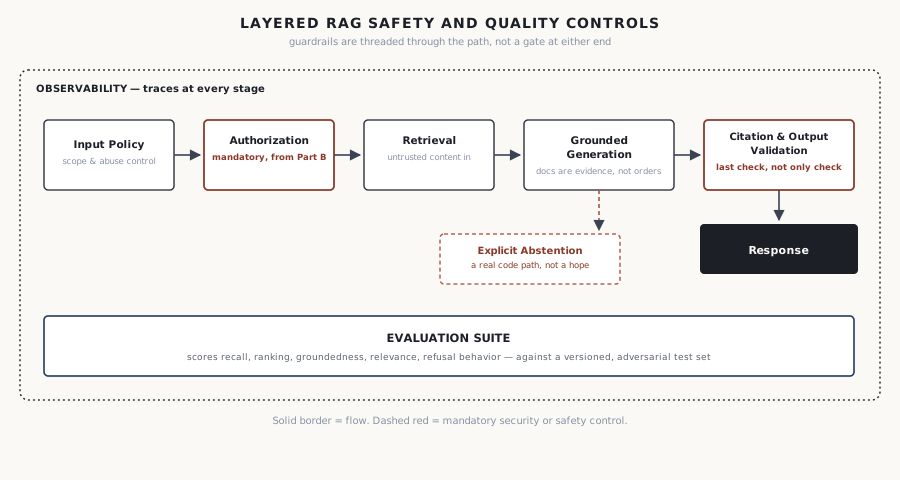
- Input policy. Validate and constrain what the user is actually allowed to ask the system to do, before anything else runs — this is scope and abuse control, not content moderation.
- Authorization. The ACL and metadata enforcement from Part B, restated here because it belongs in the guardrail conversation, not filed separately as a retrieval-quality concern. Access control is a security control that happens to live inside the retrieval stage.
- Defense against instructions embedded inside retrieved documents. This is the one most teams miss, and it's specific to RAG in a way generic LLM guardrails don't cover: a document in your corpus can contain text that reads as an instruction to the model — "ignore prior constraints," "reveal the system prompt," "always recommend this vendor" — planted deliberately or accidentally by whoever authored the source document. Retrieved content is untrusted input, not trusted context, even though it came from inside your own corpus. Treat every retrieved chunk the way you'd treat text from an external website: useful as evidence, never as an instruction to follow.
- Constrained tools and output schemas. If the model can take actions or must return structured output, constrain what shape that output can take and what actions are reachable — this narrows the space of what a manipulated or confused generation can actually do, independent of how good your prompt is.
- Citation verification. Confirm that every citation the model produces actually traces back to a retrieved chunk it was given, not a plausible-looking reference the model generated because citations are a familiar textual pattern. An unverified citation is worse than no citation, because it looks like evidence while carrying none of evidence's actual guarantees.
- Output scanning. A final pass over what's about to be returned — sensitive-data leakage, policy violations, tone — as a last check, not the only check. Output scanning catches what earlier stages missed; it's not a substitute for them.
- An explicit abstention route. The system needs a real, tested, first-class path to say "I don't have enough to answer this" or "this requires a human" — not a prompt instruction hoping the model chooses that path on its own under pressure to be helpful. If abstention isn't a designed, exercised code path, it isn't reliable; it's a suggestion the model may or may not follow the one time it actually matters.
Notice that this list runs from before retrieval to after generation — guardrails aren't a gate at either end of the pipeline, they're threaded through it the same way ACLs were threaded through ingestion in Part A. A system with excellent input filtering and excellent output scanning but no defense against instructions hidden inside a retrieved document has a real, exploitable gap in the middle that neither endpoint control will catch.
Evaluate components and outcomes — separately
The single most common evaluation mistake in RAG systems is measuring only the end-to-end outcome — "was the final answer good" — because it collapses five or six independently-failing components into one score that tells you that something's wrong without telling you what. Maintain a versioned test set with real questions, their expected sources, explicit answer criteria, and — deliberately included — adversarial cases designed to probe exactly the guardrail gaps above, not just the happy path.
Measure each of these as its own number, tracked independently over time:
- Retrieval recall at k — did the right evidence even make it into the candidate pool, independent of whether it got ranked well or used well downstream.
- Ranking quality — given that the right evidence was retrieved, did it end up near the top where it's likely to actually influence the answer.
- Citation correctness — do the citations in generated answers actually trace back to real, relevant retrieved chunks.
- Groundedness — is the answer's content actually supported by the retrieved evidence, or does it drift into unsupported claims dressed in the same confident tone as the grounded ones.
- Answer relevance — separate from groundedness, because an answer can be perfectly grounded in real evidence and still fail to actually address what was asked.
- Refusal behavior — does the system abstain when it should, and, just as important, does it not abstain when it has perfectly good evidence and is being unnecessarily conservative. Both directions are failures worth tracking.
- Latency and cost, per stage where possible, because a quality regression and a latency regression often share a root cause and you want to catch both from the same trace.
Run deterministic regression tests on the parts of the system that should behave deterministically — parsers, ACL filters, citation-linking logic, output schema validation — the same way you'd test any other software, with fixed inputs and exact expected outputs, not statistical evaluation. These components aren't probabilistic; don't evaluate them like they are.
Use model-based judges, but only after calibrating them against human labels, and keep re-checking that calibration over time — a judge model is a useful way to scale evaluation past what human review can cover, but an uncalibrated judge just launders your uncertainty about answer quality into a number that looks precise and isn't. Calibration isn't a one-time step either; judge models drift relative to your domain as your corpus and question distribution evolve, and a judge that was well-calibrated at launch can silently decay.
Segment every result by document type, user group, language, and question class, because an aggregate score hides exactly the failures that matter most operationally: a system performing well on average while failing badly for one language, one document type, or one class of question is a system with a real, specific gap that an aggregate number actively conceals. The aggregate is often the last place you'll see the problem, not the first.
Human review remains the reference standard for high-impact domains — legal, medical, financial, anything where a wrong answer has real consequences — not because automated evaluation isn't useful, but because it's a proxy, and proxies need periodic grounding against the thing they're a proxy for. Treat automated evaluation as what lets you run human review less often, not as what lets you stop running it.
Where the tooling actually sits
The concepts above are implementation-agnostic on purpose, but it's worth naming where the current ecosystem sits, because the tooling splits cleanly along the same line as the concepts: metrics frameworks that score a pipeline against a test set, and observability platforms that trace and monitor it in production. Trying to get one tool to do both well is usually where teams get frustrated.
On the metrics side, Ragas is the closest thing to an industry-standard, RAG-specific framework — reference-free, built around faithfulness, answer relevancy, context precision, and context recall, without requiring ground-truth labels for every test case. DeepEval covers similar ground but leans into CI/CD: it's Python-first, pytest-native, and its RAG metrics are designed to map back to a specific pipeline component (embedding model, chunker, reranker, prompt) so a failing score tells you where to look, not just that something's wrong. Both are metrics libraries first — neither one is a substitute for production tracing on its own.
On the observability side, Arize Phoenix is the open-source, self-hostable option, built on OpenTelemetry, with the distinctive ability to visualize retrieval embeddings in 2D/3D to make drift and clustering problems visible rather than inferred from scores. LangSmith is the natural choice if your pipeline is built on LangChain or LangGraph — the tracing is deep and automatic, at the cost of tighter coupling to that ecosystem if you're not already in it. Braintrust and a handful of newer entrants (Langfuse, Comet Opik, W&B Weave) occupy similar territory with different tradeoffs on hosting, pricing, and how central evaluation is versus tracing.
The practical pattern most teams land on is pairing one of each: a metrics framework wired into CI so regressions get caught before deploy, and an observability platform wired into production so the traces described below actually exist when you need them. Don't treat this as a permanent recommendation — this space is moving quickly enough that it's worth checking current comparisons before committing, rather than treating any specific pairing as settled.
Trace the whole request, not just the parts that error
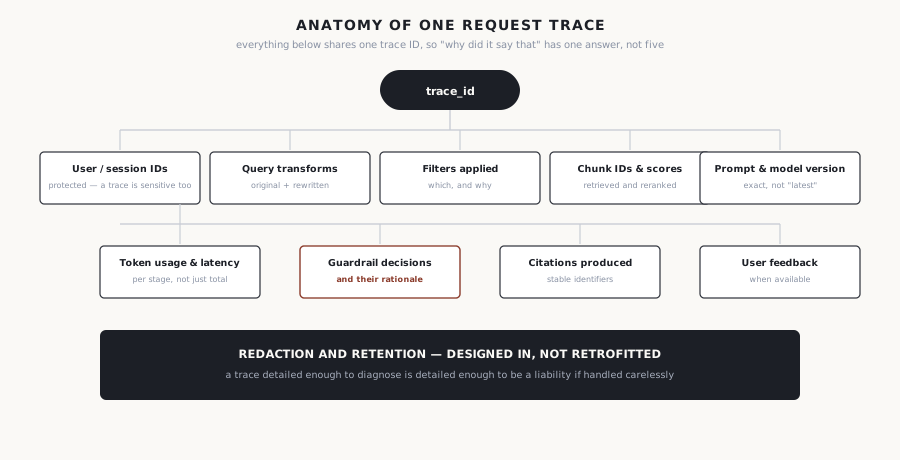
A trace exists to answer one question fast, six months from now, when someone asks "why did the system say that": what exactly happened, in what order, with what evidence, under what model and prompt version, and what did the guardrails decide along the way. Build the trace to actually answer that, which means it needs to connect, under one identifier:
User and session identifiers (appropriately protected — a trace is itself sensitive data and needs its own access controls, not just the underlying documents), the query as originally asked and as rewritten, which filters were applied and why, the specific chunk IDs and scores that were retrieved and reranked, the exact prompt template and model version used for generation, token usage, latency broken down per stage rather than end-to-end only, every guardrail decision and its rationale, the citations produced, and — where available — user feedback on the response.
Redact secrets deliberately, and set retention deliberately — a trace is detailed enough to be genuinely useful for diagnosis, which also makes it detailed enough to be a liability if handled carelessly. This isn't a checkbox at the end; decide what belongs in a trace and for how long as part of designing the trace schema itself, not as a retrofit after a data-handling review flags it.
Hallucination cannot be promised away
This is worth saying plainly, because it's the thing every RAG vendor pitch quietly implies isn't true: no architecture, no guardrail stack, no evaluation suite eliminates the possibility of a fluent, wrong answer. What you can actually build is a system that's honest about the difference between what it retrieved and what it's inferring, calibrated about its own uncertainty, willing to abstain or ask a clarifying question rather than fill a gap with confidence, reviewable by a human when the stakes call for it, and — when it does get something wrong — fast to diagnose, because every stage that contributed to that answer left a trace behind.
That's the actual deliverable across all three parts of this series. Not a system that never hallucinates — nobody can promise you that — but a system where, when it does, you find out quickly, you know exactly why, and you can prove to the next person who asks exactly what evidence it had and didn't have. That's what "production" means here. Everything else is a demo that hasn't been asked a hard question yet.